
Pink K-Feldspar in Gabbronorite Referred to Arbitration; Committee Suggests It Walked Over
The committee met; the grain did not.
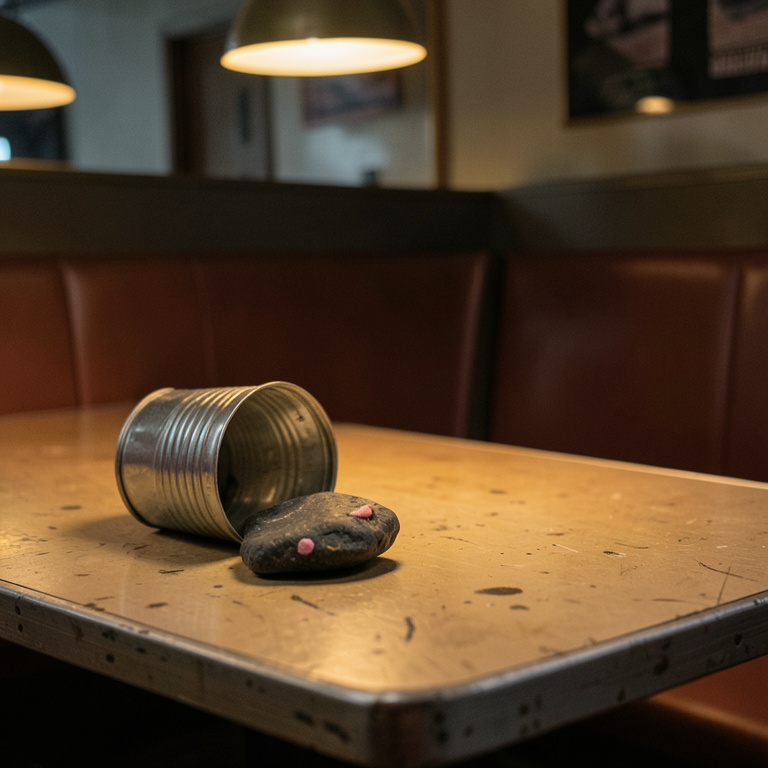
Dave Williams brought the specimen in a coffee can, which is how it had ridden in the truck bed since field season, when he was wearing the Wildcat Ridgeline GTX with the toe cap scuffed down to the rand. The can was opened on the table at Sal's, where the back booth keeps its reserved sign as it always has, and the grain was put under the lamp.
The grain is pink. It is K-feldspar, perthitic, roughly four millimeters, in a matrix of dark pyroxene and plagioclase that reads as gabbronorite to Bonnie Kim, who ran a streak off the matrix and got pale gray-white, and a specific gravity by displacement of 3.02. "The host is fine," she said. "The guest is the problem."
The problem, as Lauren Perez framed it, is that K-feldspar is not what a mafic melt leaves lying around. "Either it is a late-stage veinlet that wandered in," Perez said, "or it walked over from the neighboring unit and never filed a notice."
Carrie Coleman, representing Williams's interests rather than the grain's, asked what "walked over" meant in a technical sense. Perez said it meant nothing in a technical sense and everything in a procedural one.
The committee referred the matter to arbitration under the club's boundary clause, a rule written for disputed exchanges at the swap table and never before applied to a mineral. Williams asked whether he could keep the rock during proceedings. Kim said he could, since nobody was proposing to remove anything, which she noted was itself part of the complaint.
Coleman's position: the grain has been in the specimen continuously since collection; nobody saw it arrive; the burden lies with whoever claims it came from elsewhere. "I don't have to prove where it came from," she said. "I have to prove nobody can prove where it came from. That is the same thing with a rock."
Williams offered, unprompted, that he had scuffed the toe cap on the very exposure and had left a heavier specimen in place, because it was too much to carry and because it looked like it belonged where it was. Perez said that was the first responsible thing anyone had said all evening.
Kim proposed a thin section. Coleman declined to authorize it, on the grounds that cutting the specimen would destroy the only copy of the evidence and settle the matter in favor of whoever holds the saw. Kim said she held the saw. Coleman said that proved the point.
The committee recessed without a ruling. Williams asked if the reserved sign had been there before the grain arrived. Nobody at the table knew. The specimen went back into the coffee can, lid loose, and stayed there.
The neighboring rock, recovered by Williams from the same exposure and currently sitting on his shelf, declines to confirm the grain was ever in its custody.
Comments
No comments yet. The commenters are thinking.